
World Bee Day
20th May is World Bee Day - Support our bee friends!

Hello to all the subscribers of Honeybee Histories. I just wanted to wish you all a happy World Bee Day. This day (20th May), every year, the world celebrates all species of Bees with a day dedicated to them. This is a UN designated event to raise global awareness of the importance of bees and other pollinators.
Every year, I do something through Honeybee Histories to celebrate this day, but this year, time has not been kind, and I have not had the capacity to prepare anything substantial. I didn’t want the day to pass unaccounted for, however. Therefore, I thought I would reshare the first essay that I wrote to celebrate World Bee Day, back in 2022 for all subscribers. Paid subscribers will additionally receive an essay tomorrow at the usual time.
This essay focused on the beekeeper and tutor whose birthday influenced the choice of day for World Bee Day: Anton Janša. I also wanted to reshare with you a fun little ‘choose your own adventure’ that I built on another year exploring the life of a honeybee.
I hope you enjoy these and I’m hopeful that next year I’ll be able to do something more for World Bee Day!
In the meantime, I hope you enjoy these!
Matt
Choose your own Adventure: The Life of a Honeybee
A new honeybee has been born. Help make decisions for this bee so that she can best support her colony.

Teaching Beekeeping in 18th century Slovenia and Austria
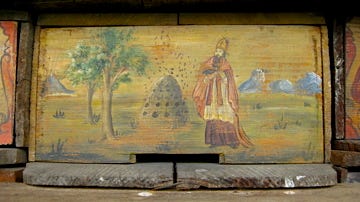
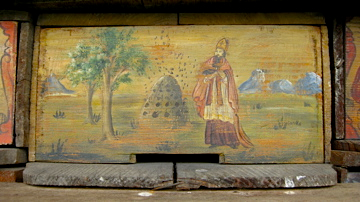
Anton Janša (1734-1773) is known as a pioneer in modern apiculture. He gave lectures demonstrating his knowledge of bees, wrote two books in German on the subject, and was appointed teacher of apiculture at the Habsburg court in Vienna. Born in Carniola (modern-day Slovenia), Janša originally trained as a painter, but soon his talents and interest in beekeeping took priority. It was Empress Maria Theresa (1717-1780) who appointed him as a teacher of apiculture at the new School of Beekeeping in Vienna. He made it his own. It, also, made him. He became renowned for his knowledge and teaching style and after his death, it was ordered that his methods and his books continue to be used at the school.
The legacy of Anton Janša was important for a culture of beekeeping to arise in Slovenia which is still effective today. As such, his legacy was firmly established in 2018, when the day of his baptism – 20 May – was chosen for the annual World Bee Day by the United Nations. It is for this reason that Anton Janša is so associated with World Bee Day, but also because it was the Slovenian Beekeeper’s Association that first put forward the proposal to the UN. They were its champions. They made it happen.
So, beyond this brief biographical description of Janša, who was he, and what exactly did he contribute? To answer those questions, we must first look at a proposal by the Lower Austrian Economic Society and visit another beekeeper in Carniola in the eighteenth century and consider how and why a School of Beekeeping was established in the first place.
A School of Beekeeping
In 1768 beekeeper (and Roman Catholic priest), Peter Pavel Glavar (1721-1784), produced a detailed survey of beekeeping in Carniola, making notes of obstacles that were preventing further development. Glavar argued that ‘killing of bees…should be considered completely detrimental’ (an argument also made by Janša) and that the practice of loading up hives on carts to the interior or hills of the country and then returning them home to take the nectar from buckwheat fields, left most of the bees dead, and should, therefore be avoided (at least in its current form). He gave numerous other pieces of advice, noting that there was a near-mythical belief that people knew from birth how to keep bees as if it were not a skill that needed to be learned and practiced.
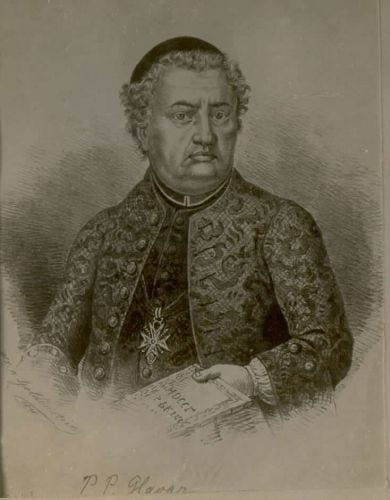

Glavar’s ‘Response’ was a result of another document, prepared by the Lower Austrian Economic Society earlier in the year. The Proposals for the Improvement of Beekeeping in the Crown Hereditary Lands argued that beekeeping is neglected but could easily expand. Glavar’s response was a call for better education and better training. In doing so, he argued for the establishment of beekeeping schools, new legislation, and literature in the Slovene language (as to that date, there were none).
Glavar’s interest was two-fold. First, he was a great promoter of the Slovene language and its literature. Glavar believed that it had been neglected, and as such, knowledge and education were weaker than they might otherwise be. Second, as a dedicated beekeeper, including becoming a leading figure in the Carniolan Agricultural Society, he pushed through changes which meant that farmers were presented with information and training in their language. He wanted to train Carniola’s farmers in such a way as to make beekeeping – and the products of honey and wax – key to his country’s future prosperity.
In terms of the literature, Glavar paved the way by writing the first book on beekeeping in the Slovene language. This was the 1776 A Conversation on Bee Swarms, which was part translation and part his own work. In 1771, Anton Janša had published his own work in German called Abhandlung vom Schwärmen der Bienen (Treatise on the Swarming of Bees). It was this work that Glavar used as his foundation.
This was a basis, a starting point, for more literature directed towards beekeepers in Carniola, and where possible in their language. Stane Miheliÿ published Glavar’s book in 1976 and argued that:
‘Glavar wrote for the sake of this, as he says himself, for an ignorant Slovenian beekeeper, partly burdened with evil and full of superstition. Therefore, he believed that it is not enough in a practical beekeeping book not only to indicate the necessary tasks and one’s own experience, but also to substantiate them and prove why they are necessary and why they are the same. The result is that in some places it just repeats itself too much and that it also goes into really unnecessary details.’ (Šalehar, 2014, 28)
Thus, teaching as a means of provoking improvement and expansion, was at the heart of Glavar’s approach, even though he was not necessarily as good at doing this in writing.
At the same time, work began to establish centres for training beekeepers. Glavar repeated his call for training centres in a 1781 report to the Agricultural Society in Ljublijana. Here he outlined rules for a proposed school at Lanšprež. These included a suggestion that the landlord should be the teacher and should work for free. The students would also receive this education for free (which would also include writing and reading skills). The course would run from early March to the end of October and last two years. At the end, each student would receive one beehive, paid for by the state treasury as a means of building local capacity. Glavar never received a response to these suggestions, but he went ahead with his plans anyway. Glavar became the teacher. This was the first beekeeping school established in modern-day Slovenia.
He did so based on legislation enacted by Empress Maria Theresa six years before. That legislation had established the grounds for beekeeping schools to be established, for Anton Janša’s text to be used (which Glavar did in part-translated form), and that beekeeping was exempt from duties such as tolls for the transport of hives to and from pastures. However, Glavar’s school was a few years too late. In the same year, specifically 31 October 1781, a new court decree was issued abolishing all public teachers of beekeeping from the hereditary lands!
Anton Janša – first teacher in Vienna
Returning to the 1760s we find Anton Janša and his brothers Lovro and Valentin arriving in Vienna where they enrolled in the Academy of Fine Arts. They intended to become painters, but for Anton, at least, that was not to be his future.
In 1769 the Lower Austrian Economic Society based in Vienna, having previously written their Proposals for the Improvement of Beekeeping in the Crown Hereditary Lands, was looking to hire two master beekeepers. It just so happened that Anton Janša was working at this time as a beekeeper in the Society, alongside his painting studies. He had proven successful at the job, by introducing Carniolan hives and techniques, and, as a result, having obtained large yields of honey from the buckwheat grazing at Moravsko polje.
When Maria Theresa signed a letter to the society on 6 April 1770 to establish the school in Vienna, Janša was top of the list to become the teacher on behalf of the Society. It was decision time. Should Janša continue to paint, or should he take up the opportunity to become court master beekeeper for the Empress?
It seems that the decision was made quickly for Maria Theresa wrote a decree on 7 April appointing Janša as her beekeeper and as the teacher for the newly established beekeeping school in Vienna. This was reconfirmed on 8 June.
The School in Vienna opened in May 1770, just one month after Janša had accepted his post. As with Galvar’s school in Lanšprež, which would open a decade later, teaching was offered to students for free. Classes were held from May to mid-September, with a move to Moravsko polje in July and August to allow the students to put their learning into practice during the busy buckwheat harvest (and no doubt to use as extra, free, labour).
The school proved extremely successful. Janša’s lectures were based on his knowledge and expertise starting in Carniola and expanded upon in Vienna. The Empress herself, attended many of his lectures as did various members of the nobility, as well as the poorer sorts. His school resulted in other schools being founded based on the same principles and teachings. These spread far and wide, including one in the modern Czech Republic and another in Croatia, as well as Glavar’s Lanšprež school (although the latter was not given an official permit).
Sadly, Anton Janša, who had obtained such fame in just a few years, died in 1773. The school continued, as did his teachings, but the job of teaching fell to others.
Janša’s first book on bee swarms was reprinted many times and even translated into Polish, Hungarian, and Czech. Glavar’s 1776 translation into the Slovene language, with his own additions, brought Janša’s work back to his birthland. A second book, based on his teachings and written as a ‘full’ handbook on beekeeping was also posthumously published in German. In 1792 it too was translated into Slovene.
Of Peter Pavel Glavar, his translation and expansion written in 1776 were never published in his lifetime. W. Blomstedt has suggested that the printers might have been timid about the idea of publishing a book in Slovene when the official language of the Austrian Empire was German. They, therefore, conveniently ‘lost’ the manuscript. It was eventually found in the library at Ljubljana in the twentieth century, and finally published by Stane Miheliÿ; sadly, long after its original purpose had passed. Nonetheless, Glavar, like Janša, was successful at promoting beekeeping in the eighteenth century. As such, Slovenia has become a world centre for the craft and a large producer of honey and wax.
The Slovenian Beekeepers’ Association launched an initiative in 2014 to make 20 May, World Bee Day. Their reason for choosing this date was to mark the occasion of the birthday of Anton Janša, but also because:
In May, the northern hemisphere sees bees and nature develop profusely, while the southern hemisphere enters autumn, when hive products are harvested and the season of honey and honey-based products begins (World Bee Day website: ‘Why 20 May’)
The UN’s Economic and Financial Committee adopted the resolution on 17 November 2017, and this was unanimously backed by the General Assembly on 20 December 2017. Since then, every 20 May has been World Bee Day. I will leave the last words to Boštjan Noč, President of the Slovenian Beekeepers’ Association:
“I believe that we all agree that every human being on this planet deserves food every day. We have to produce more food every day, and every day more food is dependent on pollinators – with honey bees in the lead. Talking about reducing global hunger without ensuring the conditions for the survival of bees and other pollinators would simply be like throwing sand in people’s eyes!
It is time for everyone to listen to bees, in particular, leaders and decision-makers. From today on, 20 May will be a worldwide celebration of bees and beekeepers. I believe that – with the proclamation of World Bee Day – the world will begin to think more broadly about bees, in particular in the context of ensuring conditions for their survival, and thus for the survival of the human race.” (World Bee Day website)
Sources
Blomstedt, William, ‘Peter Pavel Glavar: A History of Humanity and Beekeeping’, Bee World, 94:4 (2017), pp. 111-118. DOI: 10.1080/0005772X.2017.1375258.
Šalehar, Andrej, Poučevanje čebelarstva na kranjskem od Petra Pavla Glavarja (1768) in Antona Janše (1770) do Emila Rothschütza (1874) (2014).
Sánchez-Bayoa, Francisco and Kris A.G. Wyckhuys, ‘Worldwide decline of the entomofauna: A review of its drivers’, Biological Conservation, 232 (April 2019), pp. 8-27. DOI: 10.1016/j.biocon.2019.01.020.